The Globe Journal | Antara Aceh | Serambi Indonesia | Aceh Kita | Tamiang
AtjehPost | Modus Aceh | Warta Aceh | Lintas Gayo | Bisnis Aceh
Seuramoe Aceh | Seputar Aceh | Waspada | Gema Baiturrahman | Aceh Independent
Tourism and Syariah Law
Syariah law itself literally means "the path to a watering hole," it is an ethical, moral and legal framework of rulings on everyday life, including t...
Tsunami museum
The Aceh Tsunami Museum was designed by Indonesian architect Ridwan Kamil. The museum is a 2,500 m2 four-story structure; its long curving walls c...
Sabang
Sabang is a town name on a island north of Banda Aceh on the northern tip of Sumatra. Strictly speaking, the island's name is Weh Island (Pulau Weh) ...
Surfing Aceh
Unlike the rest of Indonesia, the surf season is Nov-March during the NE monsoon which blow straight offshore to the WSW facing coastline. There is ob...
Aceh Government
Within the country, Aceh is governed not as a province but as a special territory (daerah istimewa), an administrative designation intended to give the area increased autonomy from the central government in Jakarta. Aceh is lead by Governor Dr. Zaini Abdullah, and Vice-Governor Muzakkir Manaf.
Administratively, Aceh is subdivided into 18 regencies (kabupaten) and 5 autonomous cities (kota). The capital and the largest city is Banda Aceh, located on the coast near the northern tip of Sumatra. For more details please go to Aceh Government Official Site
Videos
www.aceh.net
Aceh is a special region of Indonesia, located at the northern end of Sumatra. It is close to the Andaman and Nicobar Islands of India and separated from them by the Andaman Sea. Aceh was first known as Aceh Darussalam (1511–1959) and then later as the Daerah Istimewa Aceh (1959–2001), Nanggroë Aceh Darussalam (2001–2009) and Aceh (2009–present). Past spellings of Aceh include Acheh, Atjeh and Achin. The province of Aceh has the highest proportion of Muslims in Indonesia, mainly living according to Sharia customs and laws.
Aceh is thought to have been the place where Islam was first established in Southeast Asia. In the early seventeenth century the Sultanate of Aceh was the most wealthy, powerful and cultivated state in the Malacca Straits region. Aceh has a history of political independence and fierce resistance to control by outsiders, including the former Dutch colonists and the Indonesian government.
Aceh has substantial natural resources, including oil and natural gas—some estimates put Aceh gas reserves as being the largest in the world. Relative to most of Indonesia, it is a religiously conservative area.
Aceh was the closest point of land to the epicenter of the massive 2004 Indian Ocean earthquake, which triggered a tsunami that devastated much of the western coast of the province, including part of the capital of Banda Aceh. Approximately 170,000 Indonesians were killed or went missing in the disaster, and approximately 500,000 were left homeless.[6] This event helped trigger the peace agreement between the government of Indonesia and the Free Aceh Movement (GAM), mediated by former Finnish president Martti Ahtisaari, with the signing of a MoU on August 15, 2005. With the assistance of the European Union through the Aceh monitoring mission as of December 2005, the peace has held.
Tourism and Syariah Law
Syariah law itself literally means “the path to a watering hole,” it is an ethical, moral and legal framework of rulings on everyday life, including the act of worship and all human interaction and transaction. Acehnese are devout Muslims and take religion issues seriously.
Dress Code in Aceh: There is no provincial or local law that prohibits foreign tourists (especially non muslims) from wearing shorts. Shariah law only applies to Muslims and not non muslims. Locals do realize that tourists come from countries with different norms. When entering a village in shorts for a coffee, the ladies are suggested to wear modest dressing when they sit in a local warung.
The rules of strict Muslim dress-code is required for local Acehnese but definitely NOT for tourists. As for Western style swimsuits: Bikini’s can not be worn on public beaches in Aceh. Acehnese do not wear Western-style swimsuits at the beach. Local women swim fully clothed . Western women who like to go to the public beaches of Lampu’uk/ Lhok Nga are advised to swim with a t-shirt and bermuda shorts.
**You don’t want to stand out like a pumpkin in a rice field, and if you want to show respect and be treated respectfully in return, please dress appropriately.
Alcohol Beverages, Conversions and Sex: Syariah Law in Aceh covers more than just dress codes including things such as alcohol consumption, gambling, attendance at prayers, apostasy, relationships between unmarried men and women etc. These regulations are also enforced by Sharia police in conjunction with civil authorities and there are penalties (that are enforced) for non observance.
Tsunami museum
The Aceh Tsunami Museum was designed by Indonesian architect Ridwan Kamil. The museum is a 2,500 m2 four-story structure; its long curving walls covered in geometric reliefs. Inside, visitors enter through a dark, narrow corridor between two high walls of water — meant to recreate the noise and panic of the tsunami itself. The museum walls are adorned with images of people performing the Saman dance, a symbolic gesture dedicated to the strength, discipline and religious beliefs of the Acehnese people. From above, the roof resembles a tidal wave. The ground floor is modelled on the kind of traditional raised Acehnese houses that were best equipped to survive the tsunami.
The building acknowledges both the victims, whose names are to be inscribed on the wall of one of the museum’s internal chambers, and the surviving members of the local community.
In addition to its role as a memorial for those who died, the museum also offers a place of refuge from future such events, including an “escape hill” for visitors to run to in the event of another tsunami.
Sabang
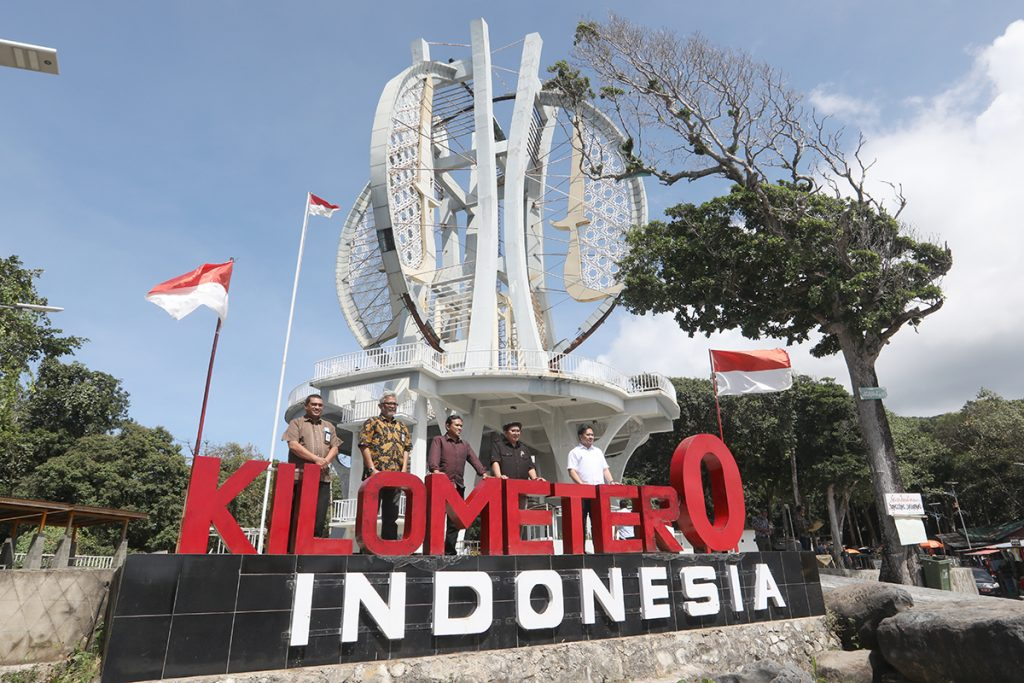
Sabang is a town name on a island north of Banda Aceh on the northern tip of Sumatra. Strictly speaking, the island’s name is Weh Island (Pulau Weh) and Sabang is the main town on the north coast, but the names are often used interchangeably. Among locals the place is more often referred to as “Sabang” but among tourists it is well known as “Pulau Weh”. The island is best known for its snorkeling and diving. Pulau Weh is a small island off the northern tip of Sumatra. The northern most point of the Indonesian archipelago is known as kilometer zero,or KMZero. It is best known by tourists for its world class snorkeling and diving.
How to get to Sabang from Banda Aceh?
Fast Ferry (~1 hour, Rp 60,000-economy 70,000-business 80,000-VIP) leave at 9.30am and 4pm from Banda Aceh and 8.30am and 4pm from Sabang Pulau Weh. For the moment the fast ferry called “Pulo Rondo” only run once a day depart from Ulee Lheue pier (Banda Aceh) at 9.30 am to Balohan (Pulau Weh)and from Balohan (Pulau Weh) at 4.00 pm. Until further notice. Motorcycles and cars are not allowed on the fast ferry but bicycles can be shipped for 50,000 idr.
- Slow Ferry (~2.5 hrs,Rp 18,000-economy 26,000-business 32.000-executive) Leaves Banda Aceh at 2pm and from Pulau Weh at 8.00am. Sometimes there are two trips/day with an extra trip at 11am.
See the diving websites of Rubiah Divers and/or Lumba Lumba for up to date information in regards to getting to and from Medan to Banda Aceh and from Banda Aceh to Pulau Weh.
Travelling from Balohan port to Sabang costs roughly Rp30,000. From Balohan port (harbour) to backpacker hangouts of Gapang and Iboih Rp50,000 (negotiable) in shared transport (~1 hr drive) and to Semur Tiga Rp25,000 in shared transport (~20 min drive). From Iboih to Semur Tiga in shared transport costs Rp100,000 (~1 hr drive). Prices for minibuses (shared transport) from and to harbour are fixed (also if there is only one passenger in the car).
A possibly cheaper option is to arrange transport in becaks or on motorbikes. For this transport you need to bargain. You can also take the whole taxi for Rp150,000. Bargain hard, since the prices are not set (although the drivers try to show you written notes with prices). A motorbike ride should cost around Rp30,000.
Alternatively you can rent motorbikes at Iboih and Gapang and Semur Tiga (Rp100,000 per day). Besides that bicycles are for rent in Iboih,Santai Sumur Tiga and several Places like Kartika and Holiday Hotel. If you want to cycle from the port to your hotel its best to rent a bicycle in Banda Aceh and take it with you on the boat.
Surfing Aceh
Unlike the rest of Indonesia, the surf season is Nov-March during the NE monsoon which blow straight offshore to the WSW facing coastline. There is obviously lots of waves in the austral winter season, but it’s plagued by almost constant WSW onshore winds so wave shape and quality won’t be optimum. Of course, there is less swell during summer, but the regulation 2-5ft conditions will provide clean fun intermediate style waves for surfers looking for friendly size surf and the adventure of mainland Sumatra travelling. There is 400km (250mi) of potential fetch in the Andaman Sea and the NE monsoon kicks up mushy 1-3ft (0.3-1m) windswells on the east coast. If the West coast goes flat, there’s always a chance of rideable, unchartered waves in Banda Aceh or Lhokseumawe. With 2ft (0.6m) maximum tidal range, tides are rarely a problem, but winds really need to be right.
Aceh-Sumatra has a tropical humid climate and experiences relatively little change in temps from season to season. The weather is warm to hot with temps ranging from 23°C to 30°C (74-86ºF). There is a dry season that generally lasts from March through August influenced by the Australian continental air masses and a rainy season from October to January, when the Asian and Pacific Ocean air masses mix. Northern Sumatra experiences the most precipitation when monsoon clouds unleash heavy downpours and average annual rainfall is 1600mm (64in). Winds are moderate and generally predictable, with monsoons usually blowing in from the south and east between June and September and from the northwest during December to March. Boardshorts are sufficient with rashies for protection from the sun & reef.
Contact: Irsyad Iskandar for information about surfing in Aceh +6282164467095 or at email irsyad.iskandar @ yahoo.com Please also see Current Surfing Condition
Tapaktuan, Aceh Selatan
The main attractions of Tapaktuan are its beaches. Here is a list of several of the most popular.
Lawang Beach: Located 20 km. north of Tapaktuan, this is an ideal place for those looking to catch some action on the surfboard. If that is you, this is a spot you don’t want to miss, with its massive crashing waves and crystal clear water. The best waves are found between July and November.
Tui Lhok Beach: This is very nice quiet beach for swimming and sunbathing, 18 km north of Tapaktuan. Every evening you can also witness a lovely, picturesque sunset over the Indian Ocean. For those of you who prefer a fresh water dip, or even those who want to wash away the sea salt, pop over to the waterfall nearby. There is also a pool available there.
Pasir Setumpuk Beach: Along the coast of this quiet beach you will find a large varietyof turtles. The clean sand, and the peaceful atmosphere make for a very natural, relaxing day.
If you are looking for some wonderful scenery, you won’t want to miss Bukit Pelita (Pelita Hill) which is very easy to reach, being located right behind the local bus station of Tapaktuan, which any passerby will be able to direct you to. Bukit Pelita offers great views of the entire town, the coastline for miles, and the sparkling waves of the Indian Ocean.
Tingkat Tujuh Waterfall, literally translated, the 7 Story Waterfall, is located approximately 7 km from Tapaktuan. However, 2 km from the waterfall, you will have to continue by foot as the roads are not wide enough for vehicles. This waterfall is appropriately named, being that it makes 7 falls, into a separate pool of its own, one at each level. These fresh, private pools definitely make the short trek worth it!
One site, associated with the Dragon legend of Tapaktuan is Makam Tuan Tapa (Mr Tapa’s Tomb), located near Bukit Pelita directly in front of the mosque Tuo, at Kampung Padang of Tapaktuan City. Make sure you visit this cemetery to see his grave,which is 10 meters long, compared long ago to the foot prints of the hermit himself.
Another exciting excursion is Gua Kalem which comes from the local dialect and means “dark cave’. It is one of the most fascinating places in Tapaktuan, though not very well known. Located a few kilometers behind Tapaktuan, beginning with a long natural tunnel, is the entrance to the caves. The tunnel is about 50 meters long and has a small stream running through it. The tunnel is home to many small bats. A bit of light seeps in but it is recommended to take a flaghlight. Follow the river upstream, climb over the rocks, and squeeze yourself through the narrow passages to find an amazing little hidden paradise. The fresh clean water is perfect for swimming, sun bathing and there is also an area where you can have a picnic and just relax. There are often monkeys around. If you continue further you will come to Panton Luas, which has a great view over Tapaktuan and the ocean.
If you enjoy jungle treks, there are two places in Tapaktuan which are worth more than at least one visit. Panton Luas, 13 km. north of Tapaktuan, has a dense forest area and a clean river. It is quiet and peaceful with nice views from the mountains. Go to the village and continue for 1 km up to Gunung Tuan where you can see monkeys and other wild animals.
Lampuuk, Aceh Besar
Lampuuk beach as well as characteristics of the beaches in Aceh, starting lengthwise, from north to south. In the past, before the tsunami occurred, at this beach is very crowded with vendors of fresh fish such as places to eat, offering to bake and bake the fish in order to be enjoyed by visitors to the beach. However, when this does not seem any place to eat like that anymore. As if left entirely together with fir tree hedge on the falling edge of the beach due to scour the tsunami.
However, very tip of the beach Lampuuk still leave a distinct exoticism bounded by high steep walls. Blue water green fluorescent nan, integrated with the blue sky and green trees on the hill was steep. A friend looked at terjalnya hill wall and mumbled the desire to climb. Surely it is also felt by the audience of the long wall when approaching this location.
Its beauty was hidden, was actually almost the same location with minutes to Lhok Nga, but the silence of this beach has to offer is a different attraction.
Here the visitor can not swim, vortex waves were too dangerous, many victims drowned trying to swim at this location. Made more appropriate place to enjoy the beautiful beaches and wild scenery.
As far as the eye could see, only the beauty of natural colors captured by the sense of sight. The sand was white sand, on several sides of the beach, sand as soft and white as the flour can be found. This beach is most fitting for the solitude, especially when the heart is troubled, with a look at its beauty, as if all the sorrow shed along with the wind blowing gently softened beaches.
Enjoying a quiet afternoon, carrying their own supplies highly recommended, be advised this is the only beach of the three beaches that discussed above, which does not offer any shop or stall that simple. Really only presents matchless beauty virgin.